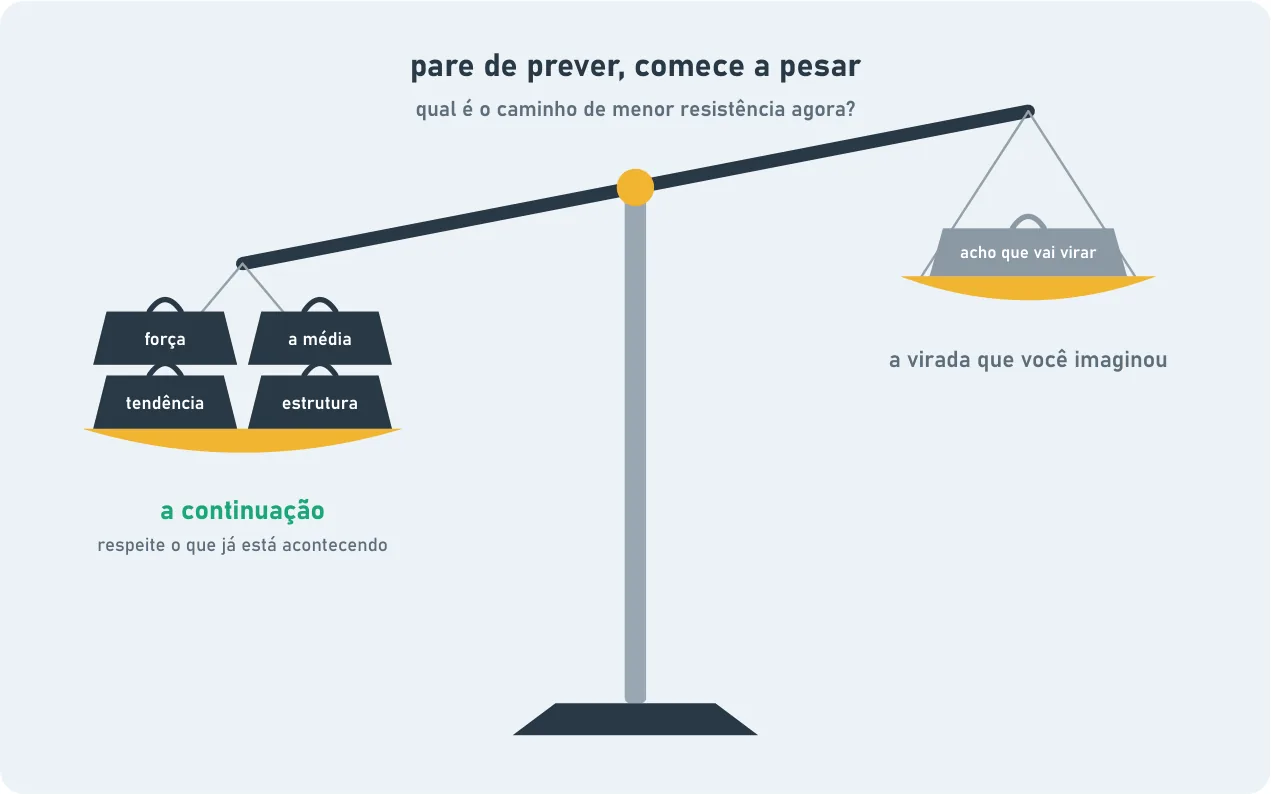
Chart + pattern + market + price = ? This is where it all comes together. The goal of a trade is not to guess the future. It's to decide which scenario has the better odds with what's on the screen right now, and to act only when those odds are on your side.
1. predicting, start weighing. Change the question. Not "where is this asset going?", but "with the trend, the structure and the strength right now, what's the path of least ?". Remember the water running down the hill, in Level 2.
2. Respect what's already happening. A price in a trend can keep going until there's proof that it changed. If the price is respecting the moving average, continuation is the scenario to weigh first, before any reversal you imagined.
3. Look through every magnifying glass. One chart shows very little. The bigger chart is what gives the context: start by zooming out. When the big chart, the medium one and the small one all point the same way, it's like swimming with the current (it's just an image). When they disagree, the current is against you, and a lot of people prefer to wait.
4. Know where you're wrong. Every scenario has a point where it dies. Before you get in, answer this: at what price is my idea definitely wrong? If the price gets there, the idea is over, and so is the trade. There's no reason to argue with the market after that.
5. Pick only the good ones. You don't have to trade everything you see. Wait for scenarios with asymmetry: a small, clear risk on one side, plenty of room to the next on the other. A stop near a strong support, with a lot of open road to the next resistance, is worth more than ten so-so trades.
The heart of the book. Don't try to be right all the time. Wait for the scenario where the odds are in your favor, define where you're wrong, and protect your money when you are.