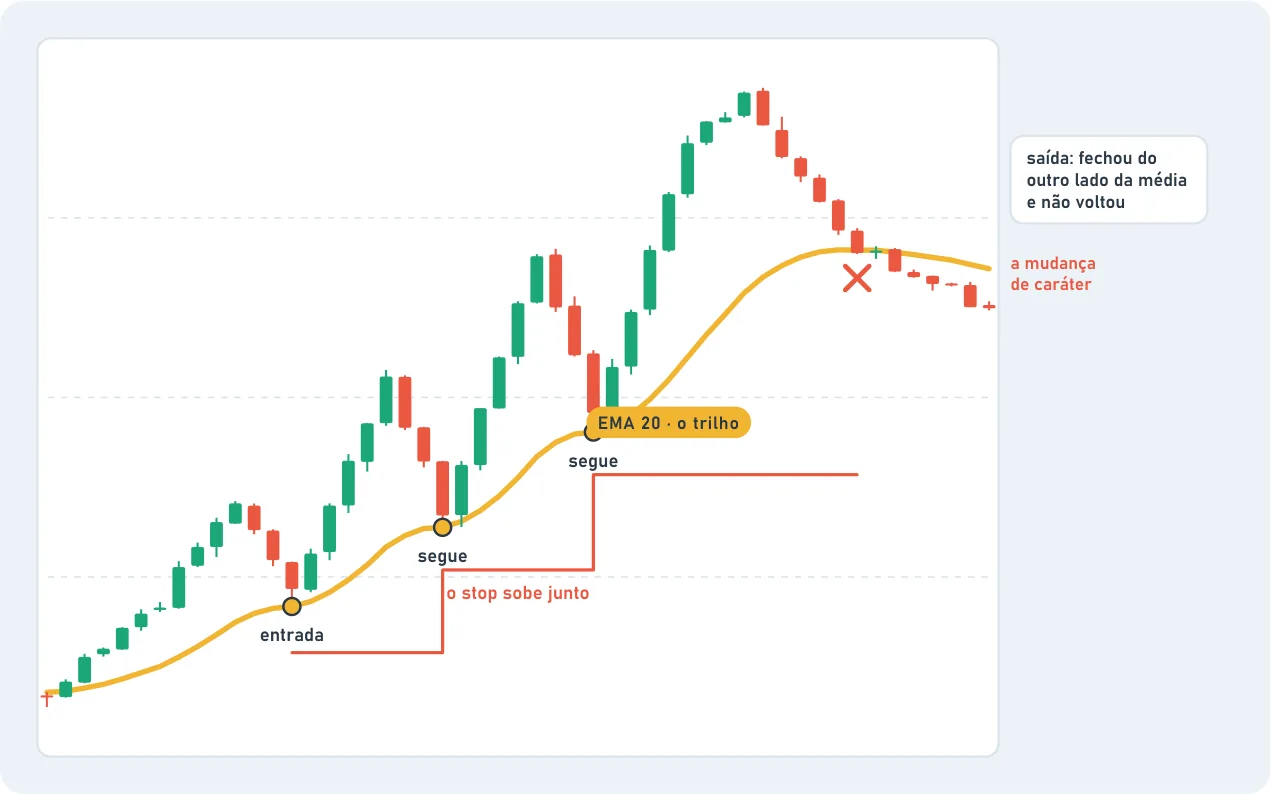
The track. A comparison: in a strong trend, the price can ride on top of a moving average like a train on its track. It pulls away, comes back, touches it and keeps going. The Rider uses that average as a guide to get in, to stay in and to get out.
12 or 20. Remember Level 2: there's no mathematical certainty. Many people use the 12 EMA for this setup, because it stays closer to the price. Others prefer the 20 EMA. What matters is which average that asset respects. Look at the history: which of the two did the price touch and bounce off more often?
Three touches before you trust it. Just like a trendline, the average only becomes a track after the price has touched it and respected it a few times.
How people who use the EMA Rider think, step by step.
The trend. Assets in a strong, clear trend. Sideways, this setup doesn't work.
No chasing. If the price is very far from the average, the idea is to wait for it to come back to it.
The touch. What does the price do when it reaches the average? Does it hold or cut through?
The confirmation on the smaller chart. When the price touches the average on the main chart, a lower timeframe shows the detail: a bounce from oversold on the RSI, a higher low, or the breakout of a small resistance.
The entry. It comes when the confirmation shows up.
One way to set it up (an example, not a rule).
Entry: on the confirmation of the touch, on the smaller chart.
Stop: below the average or below the last higher low. A trade that started from a small structure can't turn into a big loss.
Exit: in three parts, as the price moves (chapter 16). The last part stays in as long as the price keeps respecting the average. When it closes on the other side and doesn't come back, the track has ended.
The change in character. The average's biggest value isn't the entry, it's the warning. If the price has surfed the average for weeks and suddenly closes below it and stays there, something has changed. You don't have to guess the top: the average takes you out.
In downtrends too. In a downtrend, the average sits above like a ceiling, and the same reasoning works for trading short.