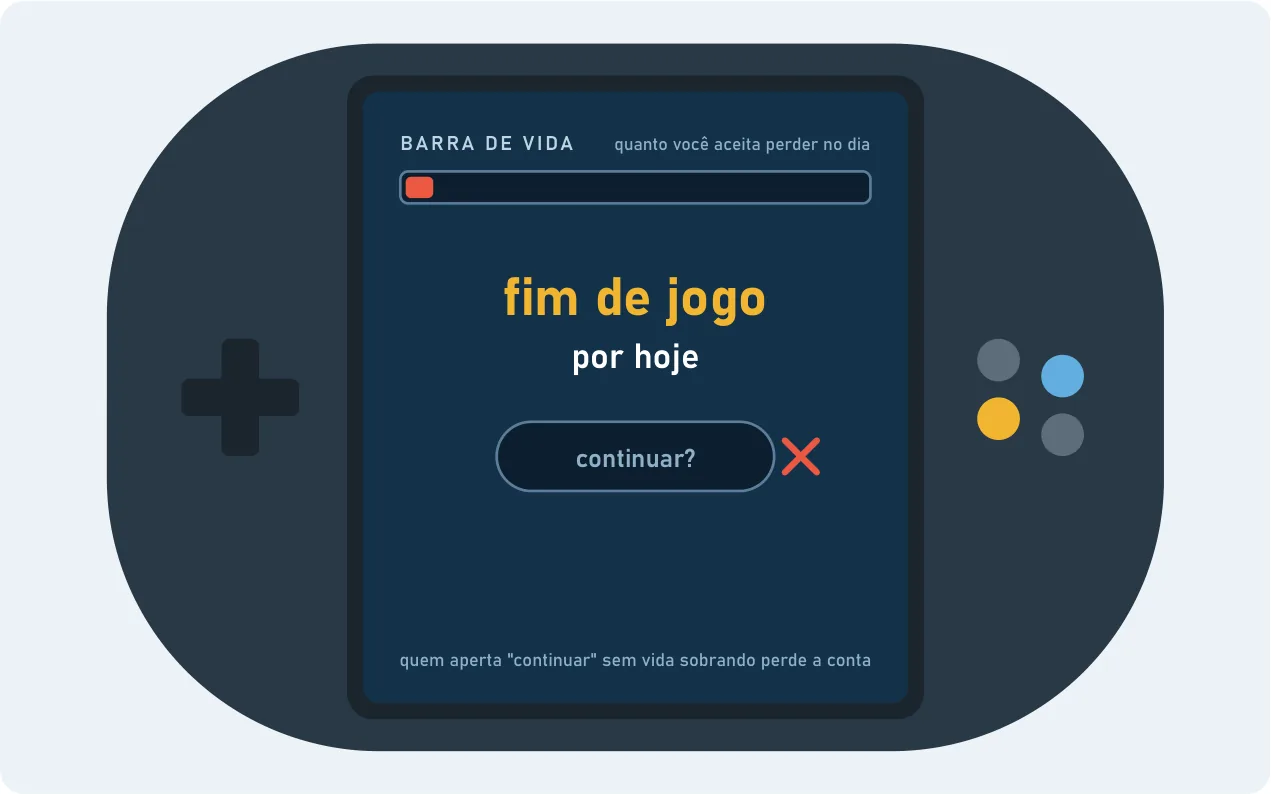
It's like a video game. A comparison: works like a game, with levels, rules and a health bar. The health bar is how much you're willing to lose in the day. When it runs out, the game is over for today, no matter how much you want to play one more. If you hit "continue" with no health left, you lose the account.
Buy and sell. Sell and buy. In day trading you don't marry the stock. In your head, it's worth zero: it's a number on the screen that goes up and down. You buy, you sell, and you keep the money to buy the next one. It's not a game of buying and holding forever.
The two pockets. In the investing pocket, a share is a small piece of a company, and you study the company. In the trading pocket, the share is worth zero in your head. Every position gets a stamp on the day it's born, and the stamp doesn't change later. How much goes in each pocket, you decide before you buy. The test is simple: if the trading pocket breaks completely, your plan still stands.
Why this also matters if you invest. Even long-term investors gain from understanding day trading: it's what shows how the price forms minute by minute, and why today's price is almost never what the company is worth. Day trading lives in the trading pocket.
The rhythm of the day. The trading session has a beginning, a middle and an end, and each market has its own hours. There's no right time to go up or down. What there is, is your chart: watch how the asset you follow behaves in each part of the day and draw your own conclusions.
The opening range. It's a well-known . The high and the low of the first 15 minutes form the opening range. People who trade this setup watch which side the price breaks the range on, and use the other side of it as a reference for the . The breakout may follow through or it may fail: the range only marks where to pay attention.
The opening rush. The first minutes gather the emotion that built up overnight. Some traders prefer to wait for that rush to pass before getting in. Some traders trade exactly that. Both approaches exist, and your journal (chapter 21) shows which one fits you.
Day trading or swing trading? The day trader gets in and out on the same day and goes to sleep with no position. The swing trader stays in for days or weeks. They both get in, often at the same point. What changes is where each one gets out and how long each can stand to stay in.
| Day trading | Swing trading |
|---|---|
| Time in the position minutes to hours | days to weeks |
| Main charts 1, 5 and 15 minutes | 4-hour, daily, weekly |
| Screen time a lot | a little |
| Overnight risk none | yes (, chapter 12) |