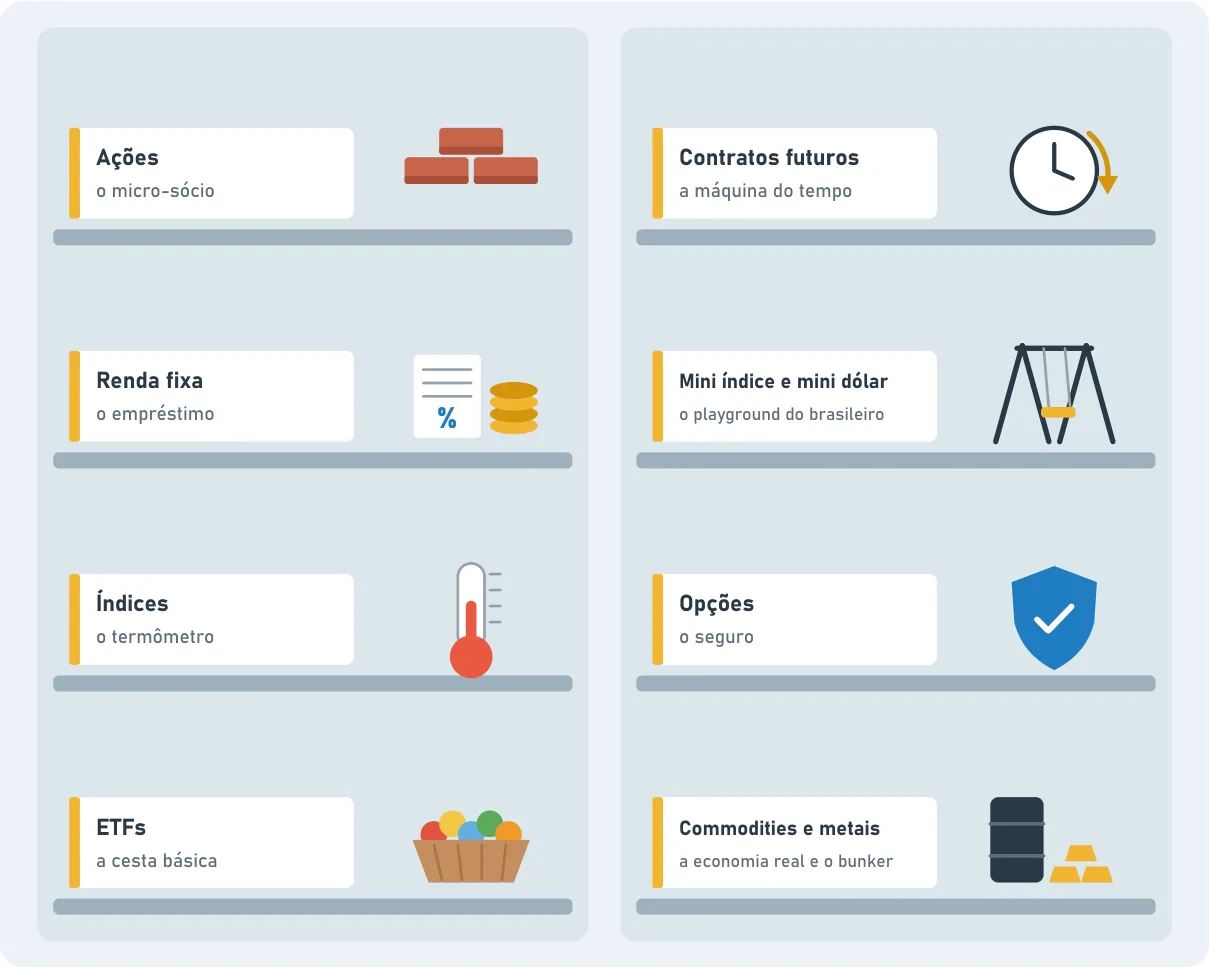
A comparison. Think of the market as a supermarket. Each shelf sells a different kind of thing. The nicknames in the table are comparisons too, just to help you remember.
| Shelf | The nickname | In one sentence |
|---|---|---|
| Stocks | the micro-partner | Tiny pieces of a real company (the little bricks from chapter 2). If the company grows, the piece tends to be worth more. |
| Fixed income | the loan | You lend money to the government, a bank or a company, and you get the interest you agreed on. |
| Indexes | the thermometer | It's not a company, it's an average. The Brazilian stock exchange index and the index of the biggest American companies show whether the overall mood is good or bad. |
| ETFs | the basic grocery basket | The ready-made package: one , and inside it comes a little bit of dozens of companies. |
| Futures contracts | the time machine | You agree today on the price of something that will be delivered in the future. |
| Mini index and mini dollar futures | the Brazilian playground | Small slices of the giant futures. The most famous ones, and the most dangerous for anyone . |
| Options | the insurance | You pay a little for the right to buy or sell something at an agreed price, up to a certain date. |
| Commodities and metals | the real economy and the bunker | Oil, soybeans, corn, cattle, coffee. And gold and silver, where money runs when panic hits. |
Fixed income, in two lines. With stocks you become a partner and share the risk. With fixed income you become a : you lend, and the deal is to get it back with interest. The risk is that the borrower doesn't pay.
Why know this before looking at a chart. Each asset has a personality. A company moves for different reasons than corn or the mini index. You don't treat the bakery the way you treat the gas station.
Some are slow and calm. Others are wild and can wipe out your account in minutes. Knowing which shelf you're on keeps you from using the right tool in the wrong place.
Nobody needs to trade everything. The menu is there so you know the shelves. A lot of people end up sticking with one or two that fit their routine, the size of their wallet and how strong their stomach is.